




For the past few years, Star Wars has been fascinated with the question of how we came to the status quo of its original trilogy of movies. Across books, comics, games, and shows we have seen the franchise engage with the road that brought us from the time of Revenge of the Sith to the start of A New Hope—and a little beyond that, with The Mandalorian’s exploration of the years after Return of the Jedi. Now, the saga is turning its eyes back further than it’s gone on screen before: and in doing so, it’s charting a whole new era of potential.
The first four episodes of The Acolyte take audiences back approximately 100 years before the events of The Phantom Menace, to a time that has been established, in Star Wars’ vast chronology, as the tail end of a period known as the “High Republic.” Explored up to the point through a transmedia series of novels and comics (as well as the animated children’s series Young Jedi Adventures), The Acolyte marks the first time this period of Star Wars has been depicted in live-action—a time period defined by the socio-political apex of two of the most important institutions of Star Wars’ prequel era, the Jedi Order and the Galactic Republic. But the first immediately intriguing thing about The Acolyte is its relative disinterest in portraying that apex: instead, it is a show that lingers in shadow, and makes its heart in an exploration of how the apex of these increasingly twinned institutions can shape and push people down paths that will eventually lead to those institutions’ decline and downfall as seen by the time of the prequel trilogy.
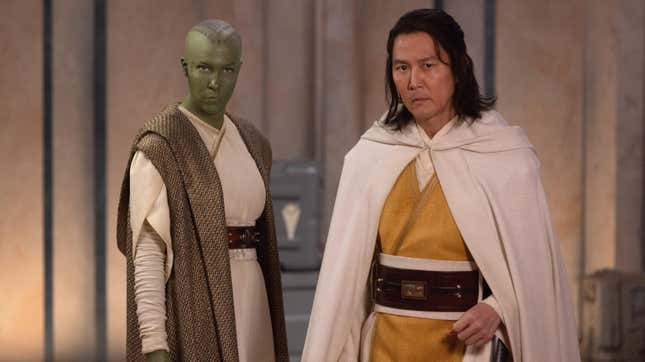
It wouldn’t be fair to The Acolyte to cast it, based on that idea, as akin to some form of Andor for the prequel age. It’s a show that pokes and prods at the systems that shape its setting in a similar manner as to how that particular series examined the structure of Empire and its impact upon the average citizen of the galaxy. But The Acolyte is much more interested in establishing a personal drama as it weaves mystery and intrigue around one very specific set of characters: a group of Jedi, targeted by a mysterious assassin named Mae (Amandla Stenberg), who seeks vengeance against the Order for reasons both systemic and personal. When an investigation is opened up into the murder of one of those Jedi, on the belief that the assailant was not just a wielder of the Force, but potentially a former member of the Order, the Jedi press Master Sol (Squid Game’s Lee Jung-Jae) into action in an attempt to uncover the culprit before the Order’s enemies—perceived or otherwise—can learn of this embarrassing vulnerability. The Acolyte sets the stage for what, on the surface, could be seen as any kind of typical Star Wars story of good and evil, light and dark, even in the relatively unexplored format of the mystery genre for the franchise. But where the series truly shines is the much greyer picture it paints, thanks to a cast of heroes and villains that are all similarly much more nuanced, flawed, and human than a descriptor like “heroes” and “villains” can really imply.
Every main character of The Acolyte, from the shadowy Mae and her allies in taking down the Jedi from their lofty perch, to the strongest and most noble members of that Order, is given the space and the exploration to be much more than just archetypes of Light and Dark. Mae is both the antagonist force that drives The Acolyte’s central mystery—why are these Jedi being targeted, and who trained her the ways of the dark side?—and also a figure given space to be sympathetic and understood in her reasons for standing against the Order. The Jedi involved in bringing her in, from Master Sol and his apprentice Jecki (Logan’s Dafne Keen), to the by-the-book Knight Yord Fandar (Charlie Barnett), are given space to be far from perfect members of their glimmering Order, whether haunted by events in their past or simply by being allowed to be brusque, annoying, or simply flawed in other way. Everyone in The Acolyte is given a depth and humanity that makes those flaws interesting catalysts for conflict, either as part of that central mystery, or among themselves, or in the service of the biggest question the show wants to ask: what is the nature of the Force as a power and spiritual identity, and who gets to dictate how it’s wielded, interpreted, and ordained, Jedi or otherwise?
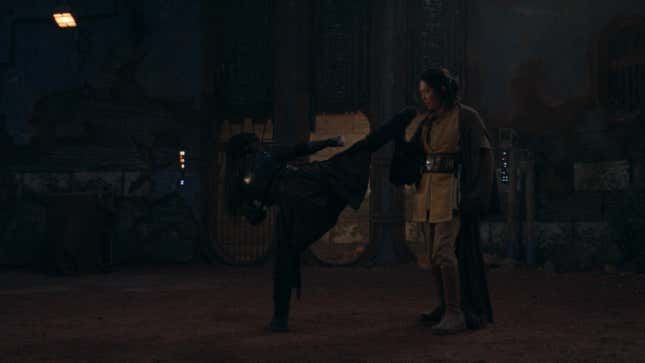
But while the series is certainly intrigued about those headier ideas—and things like what it means that a Jedi can be a total asshole, or that a dark assassin can be driven by noble goals or by their love for family and friends—and sets the stage across its front half to confront those ideas head on down the line, above all The Acolyte is a personal drama, made all the more compelling not by how it connects to the wider universe of Star Wars or these big picture ideas, but by its cast of compellingly messy central characters. It becomes clear early on that there is much more to both Mae’s plans and Sol’s investigations than either party is really aware of at first, and both characters are much more connected to the events driving the narrative than they initially thought—and that realization pulls The Acolyte down from those macro-scaled questions of institutions and ideology into a tight, character-driven mystery. It’s an early shift from what you expect the series is about into something else, but it’s a shift that keeps you intrigued, especially when the mystery twists itself from having you ask why these characters are involved, but how they connect to each other, why they’ve been shaped into the people that they are, and really, just what their deal is as flawed and damaged people.
This intimate scale gives The Acolyte a feeling that is quite unlike anything else the prior Disney+ Star Wars series have had to offer, less keen as it is on answering questions about the setting and how one major event in the canon connects to the other—for all the big deal that this is the first live-action Star Wars show set during the High Republic, the show is uninterested in trying to figure out how many of those books and comics you’ve read, and more concerned with introducing you to its characters than it is this particular era of the Star Wars world. While it remains to be seen just how compellingly the series ultimately answers the questions it raises of either its characters or the systems that have shaped them, the potential is here across these first four episodes to deliver an excellent first step into a wide new era of Star Wars ripe for exploration.
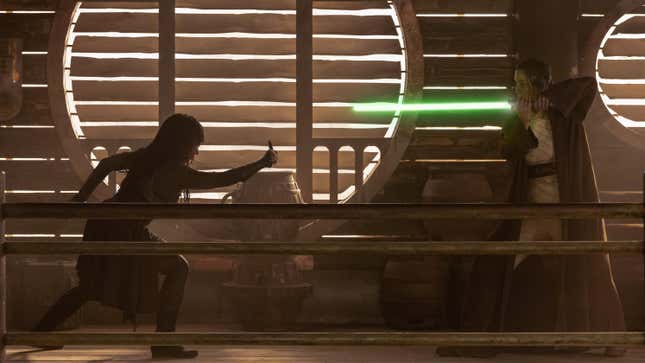
The Acolyte begins streaming today, June 4, on Disney+.
Want more io9 news? Check out when to expect the latest Marvel, Star Wars, and Star Trek releases, what’s next for the DC Universe on film and TV, and everything you need to know about the future of Doctor Who.
