




In a world of cinematic universes, it makes no sense that IF exists. You may think we mean that because IF is an original, big-budget Hollywood release, the likes of which we don’t see much anymore. But that’s not it at all. What we mean is in a sea of films that are beholden to strict rules of canon and storytelling, somehow IF was made without any acknowledgment of that. It makes rules, it breaks rules, it starts storylines and never pays them off, and in the process gives us a film that’s so maddening, any minor goodwill it gains goes right out the window. Everything that Hollywood has learned in the past few decades was not applied to IF.
Written and directed by Office star and Quiet Place director John Krasinski, IF is about a world where kids have imaginary friends (referred to as IFs), but as the kids grow older and forget about them, the IFs remain. In that world, a young girl named Bea (Cailey Fleming) discovers she can see IFs. How? Why? Don’t worry about it. She then teams up with her neighbor Cal (Ryan Reynolds), who can also see IFs, to try and match the forgotten IFs with new kids who don’t have imaginary friends. At least, that’s the first half of the movie. It’s something else in the second half, which we’ll get back to.
Now, obviously, we’re not taking issue with the idea of “Why do these magical creatures exist?” It’s a fantasy family movie. The idea is admittedly interesting and we can get behind it. No, it’s the little things. Right from the beginning you are left with questions that never get answered. Questions like, why can only Bea and Cal see all the IFs? Where do IFs come from? How do you make a new one? Not all of these have to be answered—but nevertheless, they linger. Cal is also quite the enigma, a downtrodden, borderline angry character because he feels a huge weight of responsibility from his power. Why is that? We never find out. We’ll also never quite know why Reynolds was cast as someone who smiles maybe twice in a movie but that’s a whole other complaint.
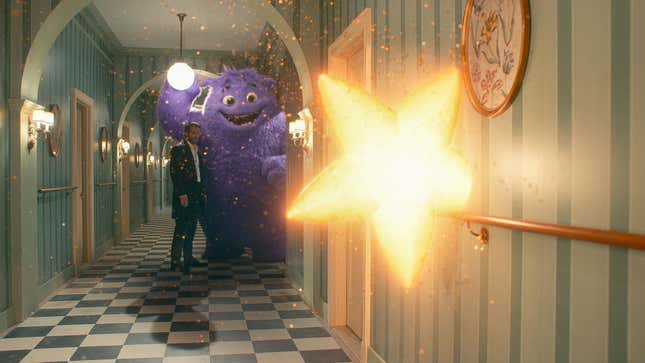
There’s more. Attempting to help the IFs, Bea and Cal go on adventures all over New York City while Bea’s father, played by Krasinski himself, is in the hospital. We never find out why specifically he’s in the hospital (it’s implied to be heart surgery) but we go with it. While there, Dad always puts on a happy face for his daughter, making jokes and playing pranks on her. It’s sweet and, you think, the precursor to something that will pay off later. It doesn’t.
Instead, the notion works against another basic consideration. While Dad is in the hospital, Bea is supposed to be under the supervision of her grandmother (Fiona Shaw). However, Grandma never once questions why Bea is running around the city with an adult stranger (to places like Coney Island which is oddly locked up in the middle of a summer day). So if Dad is okay enough to dance around and hide in the closet, we’re left wondering why Bea doesn’t spend more time with him at the hospital or why he’s there at all.
We could go on and on questioning every single decision made in IF, but hopefully you get the point. The movie simply doesn’t feel thought out in any capacity. There are major questions about character and motivation. Huge holes in the basic narrative. All of it is ripe for nitpicking. And when you’re questioning the basic plot of the movie, instead of emotionally engaging in this fantasy story, it’s a huge problem.
With no real adherence to any sense of worldbuilding, eventually IF goes completely off the rails. About halfway through the film we realize placing IFs with new kids was not the point. No, actually, it’s about reuniting IFs with their now grown-up kids. Which, we have to admit, sounds amazing. We were legit excited for the movie to present a new idea that, we hoped, would save it. But very quickly, the frustration and disappointment came roaring back. The process the characters go through to reunite is random and nonsensical. The IFs find their kid, reconnect in some way, and then… that’s it. They go home. We half thought they were going to IF heaven. Instead, a group of them have a party to celebrate a moment that came and went in an instant.
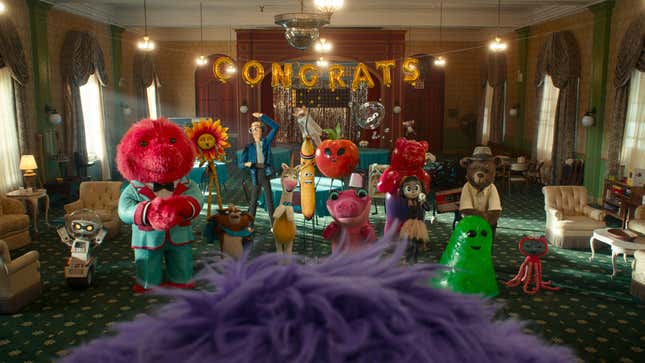
Some of this would’ve been forgivable if IF had been funny, but it’s not. It’s also not particularly charming because it’s so seeped in loss and regret. The voice cast, which is maybe the best ever assembled, is largely underused. Trailers make it seem it’s mostly about Blue, a big fluffy guy voiced by Steve Carell, but he’s only a small part of it. Actually, when you think about it, no one is really a “big” part of IF. It’s a lot of little pieces laid out the same table, but never put together.
All of this is especially true at the end when IF throws another curveball at you in the form of a Shyamalan twist. We won’t spoil the twist—but watching the film, the possibility of it crossed our minds fairly early but was quickly dismissed because we realized doing “that” would blatantly break several rules the film had previously set up and create even more plot holes and questions. So, of course, “that” is exactly what happens, adding one final cherry on top of this puzzling picture.
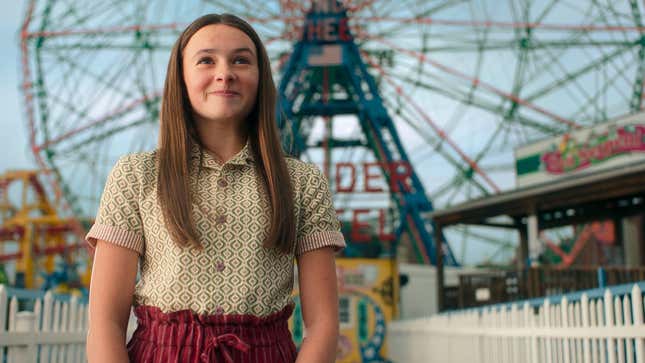
To not be a total downer, there are a few good things going on with IF. Fleming is completely charming as Bea, navigating between thinking she has to grow up and being a kid. The visual effects of the IFs are very good, especially when we see them close up. And Michael Giacchino’s string-forward score is a sure-fire earworm to go along with one or two amusing, IF-focused montages.
But even with all of that, IF just doesn’t work. Will kids watching a movie with big digital characters care about things like a cohesive plot? Probably not. But we cared. IF is a shining example of how original ideas have to be even more carefully scrutinized than adapted work. A failure for one of these is a failure for probably 10 more just like it.
The question then becomes: how did this happen? Most of us know making a movie is a process. And a big part of that process is usually a system of checks and balances in the script phase. A writer writes, and then friends, producers, maybe the actors, and on large movies like IF, executives, are supposed to read the script and ask questions. Questions like “What purpose does this character play? How does that work? Why can she do that?” But, on IF, it’s almost as if John Krasinski didn’t have any of that. We’re sure he did, but the film misses the mark and ignores so many huge issues that it fails at its basic DNA.
IF opens Friday.
Want more io9 news? Check out when to expect the latest Marvel, Star Wars, and Star Trek releases, what’s next for the DC Universe on film and TV, and everything you need to know about the future of Doctor Who.
